Nikita Nova — designer.
Why do trams in St. Petersburg need colored lights?
February 8, 2022Night, street, lantern, pharmacy,
Pointless and dim light.
Or maybe not so meaningless?
Where it all began
The light designation of trams appeared in 1908, a year after the launch of the first St. Petersburg train. This is a brilliant solution for at least three reasons:
- Population migration. Peasants begin to come to the city, who have not seen anything except a haystack, and have not ridden anything except a mare. Obviously, it is easier for them to navigate by colors than by numbers.
- Features of transport. Riddle: How many people does it take to operate a tram in the 20th century? Answer: at least two. One is a driver inside the train, the second is a switchman at a crossroads. It is more difficult to confuse a red and green signal from afar than the numbers 6 and 8. This means that the switchman will have time to react and switch the rails to the desired path.
- Landscape specificity. If you simplify the map of St. Petersburg to a diagram, you will notice that it consists of long straight segments with intersections at right angles. From the stop on Nevsky you can see the tram that crosses the Fontanka or turns onto Liteiny. The straight layout of the streets is also helped by the city’s flat topography.
These factors come together into one power ranger with the super power “Perfect Visibility”.
Previously, tickets were sold in different colors, this further helped the formation of associations among passengers. It seems that your perception is too banal and stereotyped, since you can be so easily manipulated by two light bulbs and colored tickets?
Don’t be upset, but rejoice! Allow designers to expand the zone of your unconscious decisions to leave more conscious resource for the important problems.
What does the poet have to do with it?
By the way, I’m not just quoting Blok: in the futurist’s texts you can find his tram route around the city:
Dekabristov, 57 - the house of Alexander Alexandrovich, here he wrote the poem “The Twelve”. We see the yellow and blue colors of the tram - we sit down and rush to Lenin Square. We are looking for green and white - we go to Ozerki. By the way, it is believed that it was in the smoky hall of the Ozerki station restaurant that Blok came up with (or met?) the same Stranger from the poem.
Now - to nature. In 1920, tram service opened to the village of Strelna - Blok went there in recent years to swim and walk in the fresh air.
All around - snow, trams, buildings,
And ahead there are lights and darkness.
The evolution of light navigation
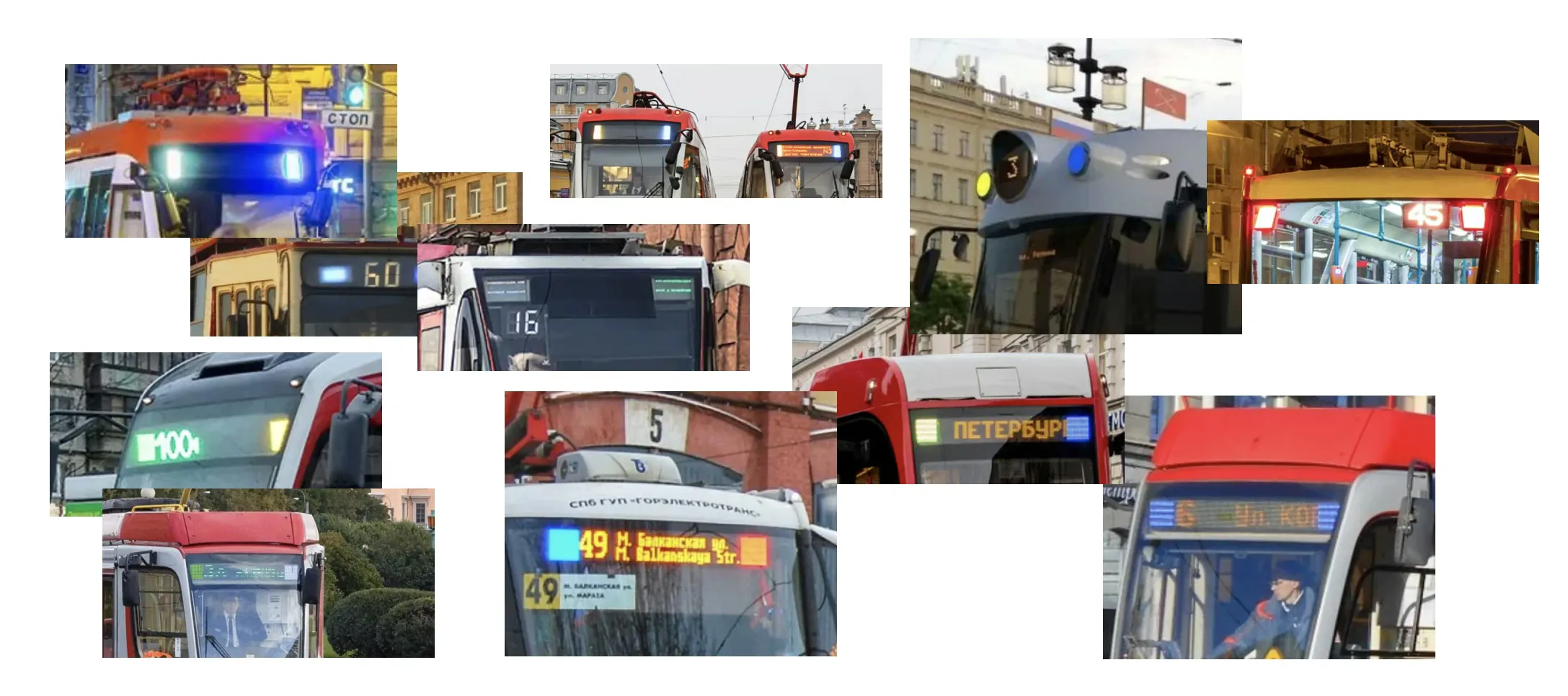
The “lights” were not always “lights”: at first there were two painted triangles in their place. Then they were replaced with colored lenses, and the “simplified” carriages of the new types did not provide space for lenses at all.
In the 70s, citizens began to increasingly ask the city government to return route lights to hundreds of trams.
And by the 1980s, large plates of colored thin glass were used on two thousand carriages, but this caused difficulties in maintenance. Would you be surprised if I told you that thin glass tends to break and that new glass is expensive to make? And “expensive” multiplied by “often” results in a complete collapse of the economy. Therefore, such trams often stood in depots rather than traveling along the streets of St. Petersburg.
Then the crisis of the 90s finally finished off the desire to design urban space to be unconsciously comfortable; there was not enough money for colored glass and painting of carriages. The idea was abandoned, and the trams ran in the form in which they remained after the experiments of the 80s. They tried to spend as little budget as possible on their production, and the glass was removed.
Later, when the crisis subsided, it became possible to use not thin colored glass, but ordinary window glass, onto which colored film was glued. Changing film on glass is still a hassle.
The 2000s have arrived: why bother with painted or glued glass, can’t you come up with something better? Bulb? Flashlight? LEDs! On new carriages produced in St. Petersburg, the lights are made up of LEDs - this allows you to change the combination of colors if the carriage is switched to another route. You no longer need to change or rub the glass, just turn on the lights and use it!
There are five primary colors used for designation: white, yellow, green, red and blue. With their help you can achieve 25 unique combinations.
Not only the combination of lights matters, but also their order. This is enough so that routes with the same lights do not intersect - they are simply placed in different parts of the city.
The result of progress is our free time
It’s hard to imagine now, but a few decades ago the main function of the metro was performed by the tram. Leningraders deservedly called it the “second metro”, and the city – “the tram capital of the world”. St. Petersburg was created for trams, remember about the terrain and street design?
The color gradation on St. Petersburg trams is the bone of a large whale of convenience. Each bone creates a world for us in which it is comfortable to unload our brain and transfer some processes to the unconscious. Turn on autopilot and spend time on happiness, people around, contemplation and work, and not remember numbers, of which there are many without trams. It seems that boards on trams and problem solving are not related things? This is true.
LEDs alone will not solve our problems. But now, when we are going home, our hand has already found the travel card while we were thinking about what to cook for dinner. We automatically boarded the tram while we were thinking about what to give to a friend.
We still have our problems, but now we have 15 seconds more to come up with a solution to them. These seconds add up, adding up to tens of minutes per day, and it’s up to you to decide what to spend them on.
And everything will repeat itself as before:
Night, icy ripples of the channel,
Pharmacy, street, lamp.